.png)
Leonardo Munoz/VIEWpress
- On Friday, the number of market losers was more than twice the number of winners in the S&P 500.
- That last happened in 1987, the day after Black Monday, top economist David Rosenberg said.
- The extremely low level of stocks participating in the market rally is cause for skepticism.
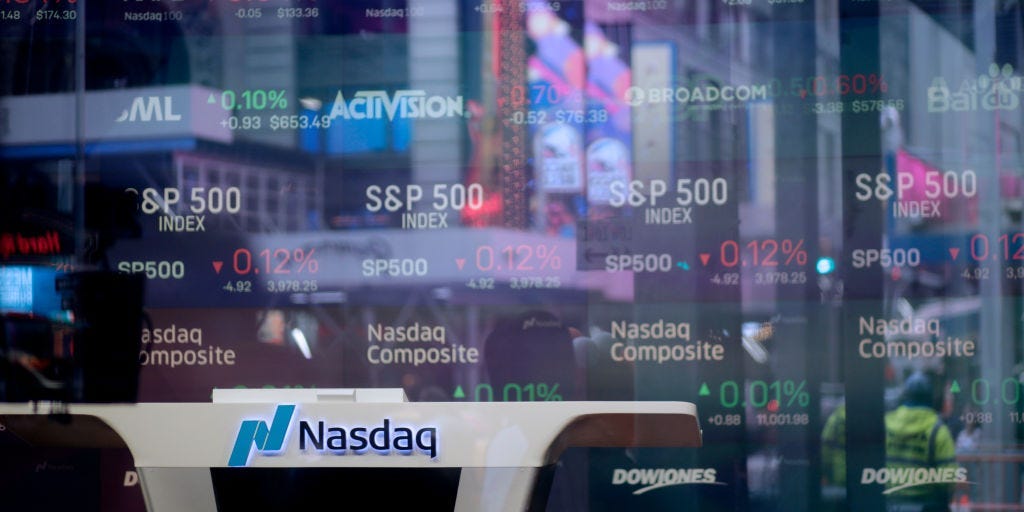
The stock market just did something for the first time since 1987. On Friday — when the Nasdaq popped, the S&P 500 closed at a record high, and the rally forged onwards — there were more than twice as many stocks in the red as those that enjoyed gains.
That last happened 36 years ago, on October 20, 1987 — the day after Black Monday, top economist David Rosenberg said.
"[On Friday,] only half the sectors were up in the ripping session, and we had to do a 'double take' after seeing that the A-D line was negative on Friday, even in the face of the +1.1% rise in the S&P 500," he wrote in a note on Monday.
"This is not ideal," Rosenberg added.
The A-D line is the difference between the number of rising stocks and falling stocks.
The number of stocks participating in the market's sugar-rush rally is pretty low. And what's underscoring that imbalance is that most of those gains belong to a coterie of tech stocks, dubbed the "Magnificent Seven." According to one BofA analyst, the group accounts for 45% of January's S&P 500 return, giving investors a dot-com bubble déjà vu.
While the S&P 500's losers-to-winners ratio was 2-1, the Nasdaq's was 1-1.5. And this poor market breadth means investors should regard the rally with skepticism, Rosenberg reiterated.
"This is a stock-picker's market, and the choices are becoming increasingly limited, with the Nasdaq especially seeing a narrowing selection of 'buys' and the index itself becoming very overextended," he said.
In fact, stocks are so overvalued that, for the price they are paying, investors are getting weaker returns in stocks than in 3-month Treasury bills. The forward price-to-earnings multiple breached 20x for the Nasdaq, which means those equities yield a 5% return, compared to the 5.39% return on the 3-month US note.
That's not normal — stocks are riskier assets than bonds, and they usually have a much higher premium because of that risk.
And while investors are praying for the proverbial soft landing, Rosenberg warned that stocks were not so overvalued the last time the Fed relaxed the brakes on the economy under Alan Greenspan in the 90s.
"Back then, it was the advent of the Internet that saved the day, and this time, ostensibly, it is all the chip spending around the generative AI craze," he said. "Just remember that we went into that last leg of the bull market with a forward P/E of 15x, not 20x."
Read the original article on Business Insider
----------------------------------------------
By: [email protected] (Aruni Soni)
Title: The stock market just did something for the first time since 1987 - and it's a sign the rally is unsustainable, top economist David Rosenberg says
Sourced From: markets.businessinsider.com/news/stocks/us-stock-market-outlook-tech-ai-bubble-dotcom-crash-economy-2024-2
Published Date: Mon, 05 Feb 2024 14:53:48 +0000
Did you miss our previous article...
https://conservativedailytimes.com/us-politics/a-boomer-uber-driver-made-over-100000-but-lost-80000-to-expenses-and-commissions-he-shares-why-he-plans-to-keep-driving